



Accurately budgeting and accruing for tax equalized assignment costs is essential to reduce year-end surprises and for keeping your mobility program financially predictable. The initial tax cost projection is the starting point which considers key elements of the assignment compensation package. However, the real challenge to maintain a reasonable accrual often comes with managing complexities that can arise once the assignment is underway.
Complexities and variables such as cross-border payroll and accounting differences, updates to the base compensation and assignment allowances, and the unpredictable impact of long-term equity incentives can significantly influence your accrual process. By understanding and proactively addressing these factors, companies can maintain appropriate accruals, support compliance, and better manage mobility budgets throughout the life of an assignment.
In this article, we explore three advanced situations that can affect your accrual process:
- Home country payroll with Host country accounting
- Ongoing accrual maintenance and changes to cost projections
- The impact of equity compensation on accruals
Home country payroll with Host country accounting
For many tax equalized assignments, employees remain on Home country payroll while the Host country bears the assignment costs. This approach is undertaken to manage risks, such as:
- It supports continued participation in Home country retirement, benefits, and social security programs.
- Paying salary in the Home country can help minimize foreign currency fluctuation risks by allowing employees to transfer only the funds needed for local expenses.
- Charging costs to the Host country entity often aligns with secondment agreements, which can reduce the risk of the Home entity being considered to have a taxable corporate presence in the Host location (i.e., permanent establishment).
Under accrual accounting, all assignment-related expenses, including income tax payments, would typically be recorded to the accrual account. In practice, this can become complicated when tax payments occur in both the Home and Host countries, particularly when payroll and accounting responsibilities are split across entities.
Case example:
Nancy is on assignment from the US to Germany. She remains on US payroll for her base salary, while some assignment benefits are paid in Germany. Her US pay includes hypothetical tax withholding, and the German Host entity pays her German income taxes through tax gross-ups processed via a shadow payroll.
A simplified monthly payroll breakdown might look like this:
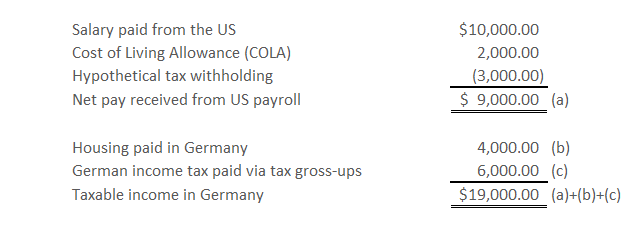
If the US entity cross-charges the German entity for Nancy’s net US pay ($9,000) and the German entity records a single entry for that amount, the hypothetical tax accrual account will be understated by $3,000 each month. This occurs because the German income taxes paid through tax gross-ups are not being separately recorded to the assignment’s tax accrual account. Over time, this can result in a shortfall when tax payments are due. Instead, the German entity should book separate entries, as shown below:

Similarly, German income taxes paid by the Host entity through tax gross-ups should not be recorded as expenses; they should be recorded to the assignment’s tax accrual account:

Because tax-related costs can easily be “buried” within payroll or cross-charge entries, it’s important to confirm all tax items are separately identified and tracked. Host country accounting teams should also understand which tax-related amounts should be recorded to the assignment’s accrual account. Common items include:
- Hypothetical tax withheld from the employee’s Home country payroll during the assignment
- Host country income taxes paid on the employee’s behalf through tax gross-ups (processed via shadow payroll)
- Tax equalization settlement payments (either paid to or received from the employee)
- Tax gross-ups related to Home and/or Host country tax liabilities
- Tax balance due payments in the Home and/or Host country
- Payments or refunds resulting from amended Home or Host country income tax returns
Accrual maintenance and changes to the cost projection
Setting up an accrual account in the first year of an assignment is critical, but it’s not a “set it and forget it” process. Without regular review, you risk unexpected tax payments that defeat the purpose of accrual planning. Assign someone internally to oversee assignment accrual accounts, determine when entries should be made, and confirm where to source the necessary information.
Like any cost accrual account, assignment accruals require ongoing maintenance to stay accurate. Costs can shift from the original projection due to factors such as:
Exchange rates
Currency values can shift frequently due to world events, market conditions, or other factors, creating variances between projected and actual costs.
Projection methodology and timing
Most projections assume all tax payments occur in the same year, with no refunds or balances due on Home or Host returns or tax equalization settlements. In reality, timing differences are common and can impact costs.
Compensation changes
Salary increases or bonuses during multi-year assignments can push employees into higher tax brackets.
Allowance adjustments
Housing or COLA amounts are often estimates at the start and may change once actual costs are known and/or due to market/policy shifts.
Assignment length changes
Assignment extensions add tax costs and may cause preferential tax schemes to expire; however, early assignment repatriations can also shift costs. For instance, ending too soon could eliminate the US Foreign Earned Income Exclusion, increasing US tax if the Host country’s rate is lower.
Tax rate or law changes
Legislative changes can potentially impact costs. Tax policies must be consistently monitored for ongoing changes and updates.
A leading practice is to update the tax cost projection annually or whenever key assumptions change. This helps quantify the impact of new variables and reconcile known tax costs already incurred.
Impact of equity compensation on accruals
Long-term equity compensation often creates tax and budgetary challenges for companies with mobile employees. From an accrual perspective, projecting the impact is difficult because the value of equity awards, and therefore related tax, depends on an unknown future stock price.
To manage this uncertainty, some companies may set a “cap” on the amount of stock option award income they will tax equalize. While a cap can limit exposure, it can also:
Increase costs
In some cases, calculations have shown that capping equity income results in higher, not lower, tax costs. Sometimes by hundreds of thousands of dollars.
Add complexity
Caps require separate calculations for equalized and non-equalized portions, which can be confusing for assignees and time-consuming for tax teams.
Leave trailing obligations
Caps don’t eliminate post-assignment reporting or filing requirements.
In some situations, equity events have minimal additional tax cost (e.g., when taxing points align in both countries and Host country tax rates are equal or less than the Home country tax rates). In these cases, it may not be necessary to include equity in the tax cost projections or accrual.
However, when taxation timing differs between countries (e.g., the UK taxes certain stock option exercises at exercise, regardless of sale, or Singapore’s timing mismatch rules), planning may be required to avoid extra costs. As well, anytime Host country tax rates are higher than Home country tax rates, there is potential for added costs due to equity income.
Finally, companies must account for trailing liabilities – tax and reporting obligations that can continue for years after the assignment ends, such as post-assignment payroll reporting, income tax filings, and Host country tax payments on vesting equity. Closing the accrual account should only happen after all final filings and payments are complete, which may be several years post-repatriation.
How to move forward
To effectively manage tax accruals, it is important to share information across functional teams throughout the assignment lifecycle and establish a regular review process for both the details and the related costs. Between review cycles, monitor for changes such as actual costs differing from initial estimates or shifts in assignment length.
When complexities arise, consult with mobility tax professionals who can help refine calculations, address timing and reporting issues, and develop strategies to reduce the potential for unexpected costs.
If your company needs support in managing the tax accrual process, our team is here to help. Schedule a call to discuss your needs.
The information provided in this article is for general guidance only and should not be utilized in lieu of obtaining professional tax and/or legal advice.