


.webp?width=880&height=588&name=Pros%20and%20Cons%20Different%20Assignment%20Structures%20(1).webp)
As companies continue to expand globally, they are placing greater focus on optimizing their business objectives and employee development. Many are reassessing the costs, benefits, and overall impact of their relocation strategies, while looking for effective ways to move talent across borders.
Traditional global mobility assignment structures remain essential tools for achieving these goals. The three most common global mobility assignment structures are long-term assignments, short-term assignments, and permanent (or one-way) transfers. Each provides distinct advantages depending on the organization’s priorities, timelines, and talent needs.
These structures help companies develop key talent, transfer critical skills, and strengthen global operations. Understanding the benefits and drawbacks of each assignment type can help mobility teams determine the right approach for both the employee and the organization.
Let's take a closer look at how these traditional assignment types compare.
Common global mobility assignment structures
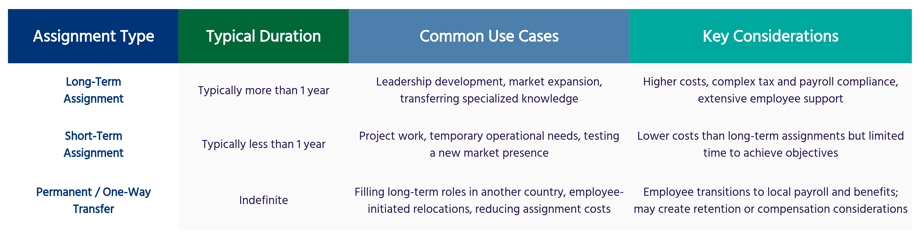
Most international employee relocations fall into one of three common structures: long-term assignments, short-term assignments, and permanent (or one-way) transfers. Each approach differs in duration, level of organizational support, and administrative complexity. Understanding how these structures compare can help mobility teams determine the most appropriate approach for a given business objective or employee situation.
Common global mobility assignment structures at a glance
Benefits and drawbacks of long-term assignments
Long-term assignments are typically used when organizations need employees to relocate internationally for an extended period, usually more than one year, to support business expansion, leadership development, or knowledge transfer.
The longer duration of these assignments allows the employees to build strong working relationships and develop in-depth knowledge that can be invaluable to your organization.
From an employee’s perspective, another advantage of a long-term assignment is the ability to remain on Home country payroll. This may allow employees to:
- Receive compensation in their Home country currency, avoiding the need to convert Host country currency to pay Home country expenses such as student loans or mortgages.
- Participate in the Home country benefit plans. For example, a US citizen/resident employee on a 3-year assignment to the UK can continue contributing to the Home country 401(k) plan, flexible spending plans, and remain covered by Home country incentive compensation plans.
- Continue participation in Home country social security, avoiding a break in the contribution period required to qualify for social security benefits upon retirement. For employees at a later stage in their career, the inability to continue participation in Home country social security may be a deal-breaker.
Despite these benefits, long-term assignments can be costly for organizations.
- Providing additional allowances and benefits for the assignee, such as cost-of-living adjustments, hardship allowances, Host country housing, and moving expenses.
- Meeting additional compliance requirements. Employees may now have both Home and Host country tax filing obligations. Organizations may also face Home and Host country reporting and withholding obligations, including administration expenses such as the cost of establishing and running a shadow payroll.
- Implementing a tax reimbursement policy for the assignee. Tax equalization remains the most common policy for long-term assignments.
- Handling on-going costs incurred for immigration, tax planning, budgeting, internal administration, etc.
- Failing to benefit from the expertise gained if the long-term assignees are not retained or placed in roles that leverage their new skills following repatriation.
It is important to note that proper planning and well-defined policies can help to reduce many of these drawbacks.
Because many factors, including employment law, tax law, immigration requirements, and bilateral tax or social security agreements, can affect the tax and payroll treatment of an assignment, organizations should consult mobility tax and legal advisors when structuring long-term assignments.
Benefits and drawbacks of short-term assignments
Short-term assignments generally last less than one year and allow organizations to address temporary business needs while limiting some of the cost and complexity associated with longer-term relocations.
Short-term assignments can provide many of the same benefits as long-term assignments, while helping address some of the associated challenges. Benefits of using short-term international assignments include:
- Like long-term assignments, an employee on a short-term assignments will often remain on Home country payroll and may receive the same benefits described above.
- The company may be able to offer a more modest compensation and allowance package to the employee, helping to reduce the overall tax and assignment costs.
- For US tax purposes, certain reimbursements, such as temporary lodging and per diems, may be paid tax-free for qualifying temporary assignments of one year or less. Other countries may have similar rules for temporary assignments.
- Depending on the availability of income tax treaties and social security agreements, Host country taxes may be avoided or limited. For example, an employee on a five-month assignment from the US to the UK may avoid UK income tax if they spend less than 183 days in the UK during a 12-month period, remain on US payroll, and have compensation costs borne by the US entity. The availability of a social security totalization agreement would also allow the employee to remain on US rather than UK social security through obtainment of a certificate of coverage from the US Social Security Administration.
- Short-term international assignments could result in a larger pool of potential employees for the international assignment program.
Despite these advantages, the shorter duration may not provide enough time for the organization and assignee to accomplish all the assignment’s objectives. Additionally, the employee may not have enough time to fully “settle in” and develop relationships with the Host country office and clients.
Compared to a long-term assignment, short-term assignments typically (though not always) result in lower tax and assignment costs for the company. However, it is important to consider factors that may lead to additional cost, such as:
- Depending on the location and the scenario, placing an employee on a structured assignment policy may be less costly than reimbursing temporary living expenses through per diems and other expense reimbursements.
- Administering a short-term international assignment may take more time than a long-term assignment. This could happen if the length of the short-term assignment changes and requires more constant support from the program administrator and/or tax services provider (e.g., monitoring assignment timelines).
- Certain exclusions (e.g., Foreign Earned Income, housing) and foreign tax credits may be available on a qualifying employee’s US federal individual income tax return that help alleviate double taxation. However, these benefits may not apply in short-term assignment scenarios, which could result in a higher overall tax cost for the company compared to an assignment that lasts just over one year.
- An employee on a long-term assignment may be able to break state residency during the assignment period, while an employee on a short-term assignment generally will not. As a result, state tax costs for the company may be higher for short-term assignments.
Benefits and drawbacks of permanent/one-way transfers
Permanent or one-way transfers involve relocating an employee to another country on an indefinite basis, typically transitioning the employee to local payroll and benefits in the Host location.
Transferees will typically receive less company support than assignees. For example, instead of receiving allowances designed to keep an individual in a neutral purchasing position in comparison to their Home location (i.e., through provision of housing, cost-of-living, and other allowances), a transferee may receive a local pay package with limited or no allowances. Instead of tax equalization, the employee may receive limited tax compliance assistance, such as tax return preparation in the Home and Host countries for the year of transfer. Due to this reduced level of support, transfer cases may initially have lower overall costs for the company than assignments.
Permanent transfers are often considered in scenarios where specific skills are needed/not available in the Host location, where the cost of another type of assignment is considered too high, or for employee-initiated moves. Because of the transfer to local payroll, administrative costs and complexities may also be reduced as the Host country entity would be responsible for handling reporting or withholding obligations. In addition, the risk of creating a taxable presence for the Home country entity (e.g., permanent establishment) is also reduced, as the individual has severed employment ties in the Home country.
Despite these potential benefits, a transferred employee will typically receive compensation in Host country currency, and Host country benefits may differ from Home country benefits. Transferees are generally not eligible to contribute to Home country retirement or benefit plans such as the 401(k) plan for US employees or contribute to Home country social security. This may be a significant drawback for senior or executive-level employees, or those approaching retirement. Additionally, employees take on exchange rate risk, possible cost-of-living issues, and potentially higher taxes.
From a talent management perspective, it may also be more difficult or costly to later relocate an employee who has been transferred rather than assigned to a location. A transferee will now be tied to a pay package and cost-of-living in the Host location, which will create a new point of reference for future moves.
What is the appropriate relocation type for your company?
As discussed above, the appropriate relocation structure for a given employee and organization depends on several factors. When evaluating these options, organizations should consider questions such as:
- Why is the employee relocating? Is the move employee-initiated or driven by a business need?
- What business objectives does the relocation support? Is the proposed timeline sufficient to achieve those goals?
- Does the relocation align with the employee’s career development and personal circumstances?
- Does the relocation support the employee’s longer-term career development? For example, will the organization have a clear repatriation plan to retain the employee and use their knowledge and experience gained during the assignment?
Selecting the right global mobility assignment structure requires balancing business objectives, employee development goals, tax considerations, and overall program costs. Each organization’s mobility program will require a slightly different approach.
If you have questions about assignment structures or how different relocation approaches could impact your global mobility program, schedule a consultation with our team.